Disability-Owned Businesses
Disability-Owned and Accessible Salons Near Me: How to Find Beauty Businesses That Are Actually Usable in 2026
Updated July 4, 2026Local SEO Guide
On this page (10 sections)
- Why accessible salon information matters
- Disability-owned vs. accessible vs. disability-friendly
- What customers may need to know before booking
- How to search for accessible salons near you
- Questions to ask before booking
- How salons can make their profiles more useful
- Disability-owned beauty businesses deserve better visibility
- How to support accessible and disability-owned salons
- What to include in an accessibility-focused review
- FAQ
Searching for accessible salons near me is different from searching for most local services.
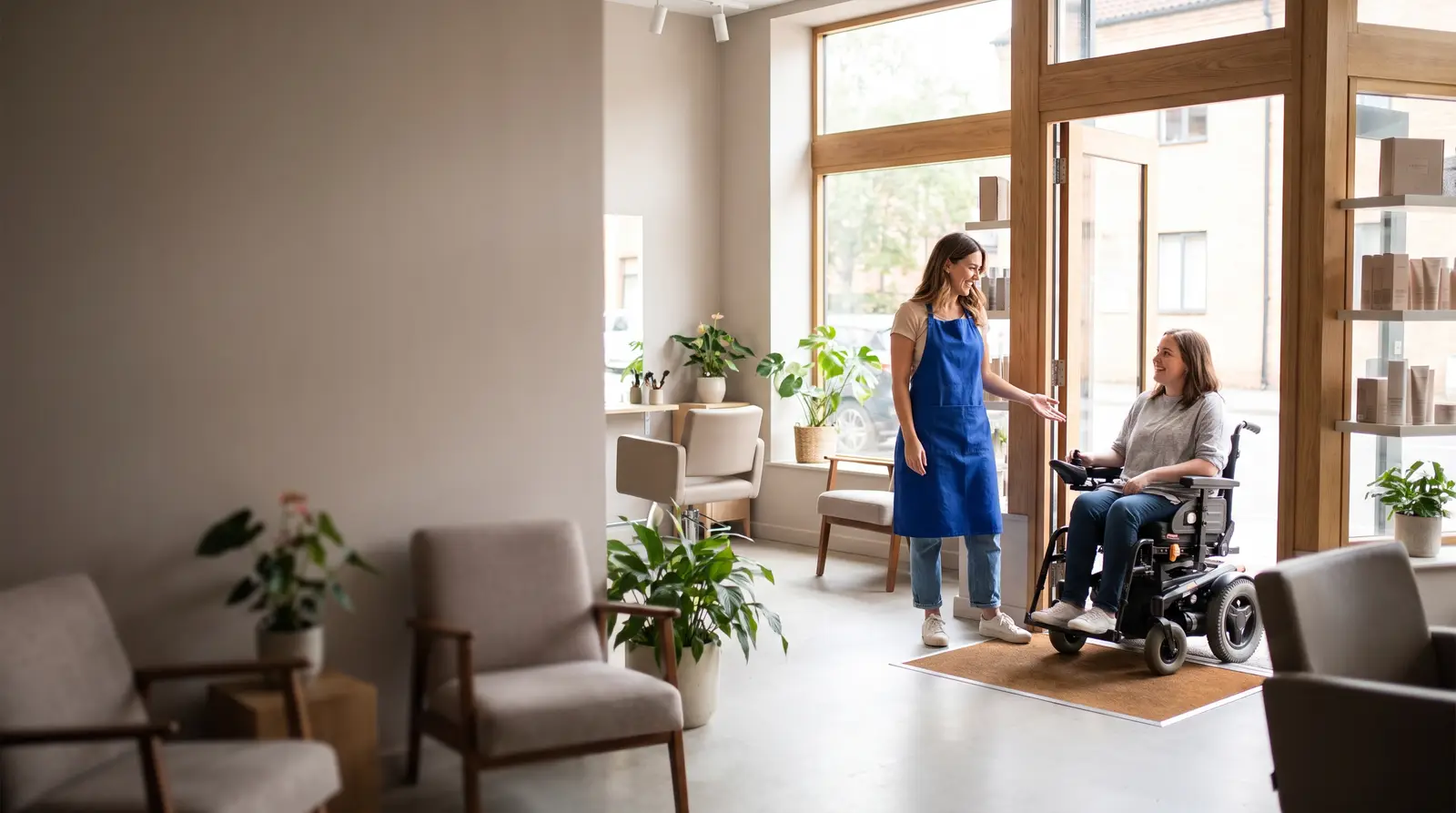
For many people, a salon appointment is not just a haircut, manicure, shave, facial, waxing appointment, or color service. It can involve parking, ramps, narrow doors, shampoo bowls, transfer needs, fragrance exposure, bright lights, loud dryers, sensory overload, long sitting times, restroom access, service animals, communication preferences, anxiety, chronic pain, mobility devices, and whether the staff will treat a customer with dignity.
That is why this guide covers two related but different things:
- Disability-owned salons — beauty businesses owned, operated, managed, and controlled by people with disabilities.
- Accessible or accessibility-forward salons — beauty businesses that provide clear, practical access information for disabled customers.
Why accessible salon information matters
Most local directories are not built for disabled customers. They may list a star rating, phone number, map, and photos, but they often leave out the details that determine whether someone can actually use the business.
A salon may say “wheelchair accessible” but still have:
- A heavy front door with no automatic opener.
- A tight waiting area.
- A shampoo bowl that is difficult to use.
- No accessible restroom.
- No room for a wheelchair next to the styling station.
- No clear parking instructions.
- Loud music, strong fragrance, or bright lighting.
- No information about service animals.
- No way to request extra time or a quieter appointment.
On the other hand, a salon may be very accommodating but never describe it publicly. That means customers have to call, explain personal needs, and hope the person answering understands.
Disability-owned vs. accessible vs. disability-friendly
These terms should not be mixed together.
| Term | What it means | What it does not mean |
|---|---|---|
| Disability-owned salon | The business is owned by a person or people with disabilities | It does not automatically prove the space is accessible for every disability |
| DOBE-certified business | A certified Disability Owned Business Enterprise | It does not guarantee every customer access feature |
| Accessible salon | The physical space, policies, or services include useful access features | It does not prove disability ownership |
| Wheelchair-accessible salon | The salon has features usable by wheelchair users | It may not address sensory, hearing, vision, or cognitive access |
| Sensory-friendly salon | The salon offers lower-stimulation options | It may not be physically accessible |
| Disability-friendly salon | General welcoming language toward disabled customers | Too vague unless supported by specific details |
Disability:IN says DOBE certification requires businesses to be at least 51% owned, operated, managed, and controlled by people with disabilities. That is an ownership verification standard. Accessibility, meanwhile, is about the customer experience and the actual usability of the space or service.
What customers may need to know before booking
Accessibility is specific. “ADA accessible” or “everyone welcome” is not enough.
A strong profile should include details like these:
| Access detail | Why it matters |
|---|---|
| Step-free entrance | Helps wheelchair users, scooter users, walker users, parents with strollers, and people with balance issues |
| Door width or entrance notes | Narrow doors can make a business unusable |
| Accessible parking | Distance, curb cuts, and parking layout can determine whether someone can enter safely |
| Restroom accessibility | A long service may be impossible without restroom access |
| Styling station space | Wheelchair users may need room beside or instead of a salon chair |
| Shampoo bowl alternatives | Traditional shampoo bowls can be painful or inaccessible for many customers |
| Quiet appointment times | Helpful for autistic customers, people with migraines, PTSD, anxiety, or sensory sensitivities |
| Fragrance notes | Important for customers with asthma, allergies, migraine, or chemical sensitivity |
| Lighting notes | Bright lights can affect people with migraine, sensory sensitivity, or vision conditions |
| Service animal policy | Businesses should understand access requirements and not create unnecessary barriers |
| Communication options | Text, email, captions, written instructions, ASL availability, or visual consultation aids |
| Extra time availability | Helpful for customers with mobility, pain, fatigue, anxiety, or communication needs |
| Private room availability | Helpful for modesty, religious hair practices, sensory needs, or privacy |
How to search for accessible salons near you
Try search terms that match specific access needs.
| Search need | Search terms to try |
|---|---|
| General access | “accessible salon near me,” “disability-friendly salon near me,” “wheelchair accessible salon near me” |
| Mobility access | “salon with wheelchair accessible entrance,” “barbershop wheelchair accessible near me” |
| Sensory access | “sensory friendly haircut near me,” “quiet salon appointment near me,” “autism friendly hair salon near me” |
| Communication access | “salon text booking near me,” “deaf friendly salon near me,” “ASL hair salon near me” |
| Private services | “private salon room near me,” “private hair appointment near me” |
| Ownership | “disability-owned salon near me,” “DOBE certified salon near me,” “disabled-owned beauty business near me” |
| City-specific | “accessible salons in [city],” “wheelchair accessible barbershop in [city]” |
Questions to ask before booking
Customers should not have to educate every business. But until directories improve, it can help to ask specific questions.
For mobility access:
- Is there a step-free entrance?
- Is the doorway wide enough for a wheelchair or scooter?
- Is there accessible parking nearby?
- Can I remain in my wheelchair during the service?
- Is there space next to the station?
- Is the restroom accessible?
For sensory access:
- Do you offer quieter appointment times?
- Can music be lowered during my appointment?
- Are fragrance-light appointments possible?
- Are there times when blow dryers are less active?
- Can I wait outside or in my car until my appointment begins?
For pain, fatigue, or chronic illness:
- Can we build in breaks?
- Can the appointment be split into shorter sessions?
- Can I avoid certain positions at the shampoo bowl?
- Is there a more supportive chair option?
For communication:
- Can I book by text or email?
- Can consultation notes be written down?
- Can a support person attend?
- Do you provide captions, visual references, or written aftercare instructions?
How salons can make their profiles more useful
Beauty businesses do not need to be perfect to be listed. They need to be honest and specific.
Instead of writing:
We are accessible.
Write:
Our entrance is step-free from the parking lot. The restroom is not wheelchair accessible. We can create extra space at one styling station with advance notice. Text booking is available. Fragrance-light appointments may be available on weekday mornings.
That second version is more honest, more useful, and more trustworthy.
Suggested accessibility profile fields:
| Field | Example response |
|---|---|
| Entrance | Step-free front entrance; manual door |
| Parking | Accessible parking in front lot; curb cut near entrance |
| Restroom | Not wheelchair accessible |
| Station setup | One station can accommodate wheelchair users with advance notice |
| Shampoo options | Traditional shampoo bowl only; towel/water spray alternatives available for some services |
| Sensory notes | Quieter appointments available Tuesday mornings |
| Fragrance notes | Fragrance-light service available by request; products vary |
| Communication | Text booking available; written aftercare available |
| Support person | Support person welcome when space allows |
| Service animal | Service animals permitted |
Disability-owned beauty businesses deserve better visibility
Disability-owned salons, barbershops, spas, and beauty studios are often under-discovered. Some owners disclose disability publicly; others do not. Some pursue DOBE certification; many do not because certification may not be necessary for their customer base.
Suggested ownership options:
- Disability-owned
- DOBE-certified
- Service-disabled veteran-owned
- Disabled founder
- Neurodivergent-owned
- Chronic illness-owned
- Accessibility-forward business
- Accessibility details provided
The owner should control which labels appear publicly.
How to support accessible and disability-owned salons
| Action | Why it helps |
|---|---|
| Book with businesses that publish access details | Rewards transparency |
| Leave access-specific reviews | Helps future customers understand the experience |
| Do not punish honest limitations | A business that says “restroom not accessible” is being more helpful than one that hides it |
| Share accurate information | Accessibility misinformation can waste time or create unsafe trips |
| Respect disability privacy | Do not out an owner, stylist, or customer |
| Tip and pay fairly | Accessible service often requires extra preparation and time |
| Give feedback kindly | Businesses may not know which details are missing |
| Submit profile updates | Directories improve when customers share verified details |
What to include in an accessibility-focused review
A helpful review might say:
The entrance was step-free and there was enough room for my wheelchair at the styling station. I called ahead and they moved a chair before I arrived. The restroom was tight, so I would call ahead if that matters for your visit. The stylist was respectful and did not make the appointment awkward.
Or:
I booked a quieter morning appointment because I get migraines. The salon lowered the music, used minimal fragrance products, and let me take a short break during the service. That made a huge difference.
Reviews like this can be more useful than photos or star ratings.
FAQ
Is a disability-owned salon automatically accessible?
No. Disability ownership and customer accessibility are different. A disability-owned business may still operate in a building with limitations. An accessible salon may not be disability-owned. Both labels should be listed separately.
What is DOBE certification?
DOBE stands for Disability Owned Business Enterprise. Disability:IN says DOBE certification requires businesses to be at least 51% owned, operated, managed, and controlled by people with disabilities.
What should an accessible salon listing include?
At minimum: entrance details, parking, restroom access, station setup, booking options, sensory notes, communication options, and any known limitations.
What if a salon is not fully accessible?
Partial information is still useful. A business should be honest about what it can and cannot accommodate. Customers can then decide whether the space works for them.
Keep reading
Disability-Owned Businesses
Disability-Owned and Accessibility-Forward Brands to Support in 2026
Disability-Owned Businesses
Disability-Owned and Accessible Wedding Vendors Near Me: A 2026 Guide for Inclusive Weddings
Disability-Owned Businesses
Disability-Owned Businesses in 2026: How to Find, Support, and Build More Accessible Local Economies
Own or know an inclusive business?
List it free so people can discover it year-round — with a source you control.
List your business