Disability-Owned Businesses
Disability-Owned and Accessible Wedding Vendors Near Me: A 2026 Guide for Inclusive Weddings
Updated July 4, 2026
On this page (14 sections)
- Why accessibility matters in weddings in 2026
- Disability-owned vs. accessible vs. disability-friendly
- Vendor categories where accessibility matters most
- How to find accessible wedding vendors near you
- Accessibility questions for venues
- Accessibility questions for planners
- Digital accessibility matters too
- How to talk about access needs without making guests feel singled out
- How to verify disability ownership respectfully
- What an accessibility-forward review should include
- Mistakes to avoid
- FAQ
- Suggested external sources
- Bottom line
A wedding can be beautiful and still be inaccessible.
A venue may have a gorgeous staircase and no practical step-free entrance. A photographer may create stunning images but not know how to pose wheelchair users respectfully. A DJ may keep the party going but ignore sensory needs. A planner may build a perfect timeline for nondisabled guests while leaving disabled guests, elders, neurodivergent guests, and chronically ill family members to figure things out on their own.
That is why searches like accessible wedding vendors near me and disability-owned wedding vendors near me matter.
But these searches are not the same. A vendor can be disability-owned. A vendor can be accessible. A vendor can be disability-friendly. A vendor can be experienced with disabled couples and guests. A vendor can be none of those things and still use vague inclusive language.
This guide explains the difference, how to find disability-owned and accessibility-forward wedding vendors, what questions to ask before booking.
Why accessibility matters in weddings in 2026
Weddings are a major service economy. The Knot Worldwide reported that about 2 million U.S. couples married in 2025, contributing to an over-$100 billion wedding industry, with an average wedding cost around $34,000.
When people spend that much money on a wedding, accessibility should not be treated as an afterthought.
Accessibility affects:
- Disabled couples
- Disabled guests
- Older relatives
- Pregnant guests
- Neurodivergent guests
- Deaf and hard-of-hearing guests
- Blind and low-vision guests
- Guests with chronic illness
- Guests using mobility aids
- Guests with sensory sensitivities
- Vendors and staff with disabilities
An inclusive wedding is not only about who is invited. It is about whether people can actually participate.
Disability-owned vs. accessible vs. disability-friendly
These terms are often mixed together, but they should be kept separate.
| Term | What it means | What to verify |
|---|---|---|
| Disability-owned wedding vendor | The business is owned by a person or people with disabilities | Self-identification, DOBE certification, founder statement, or direct confirmation |
| DOBE-certified vendor | A Disability-Owned Business Enterprise certified through Disability:IN or a recognized process | Certification status and scope |
| Accessibility-forward vendor | Vendor intentionally designs services to be accessible | Policies, examples, process, equipment, communication methods |
| Accessible venue | Physical and/or digital access is built into the venue experience | Entrances, parking, restrooms, paths, seating, elevators, signage, website accessibility |
| Disability-friendly vendor | Vendor is respectful and experienced with disabled clients or guests | Reviews, examples, training, planning questions |
| ADA-compliant | A legal/regulatory concept, often used casually | Ask what specifically is compliant; do not rely on the phrase alone |
Disability:IN says DOBE certification generally requires a business to be at least 51% owned, operated, managed, and controlled by people with disabilities. That is an ownership standard. It does not automatically prove the vendor’s services are accessible in every situation.
Likewise, a venue may be accessible but not disability-owned. Both facts can be useful.
Vendor categories where accessibility matters most
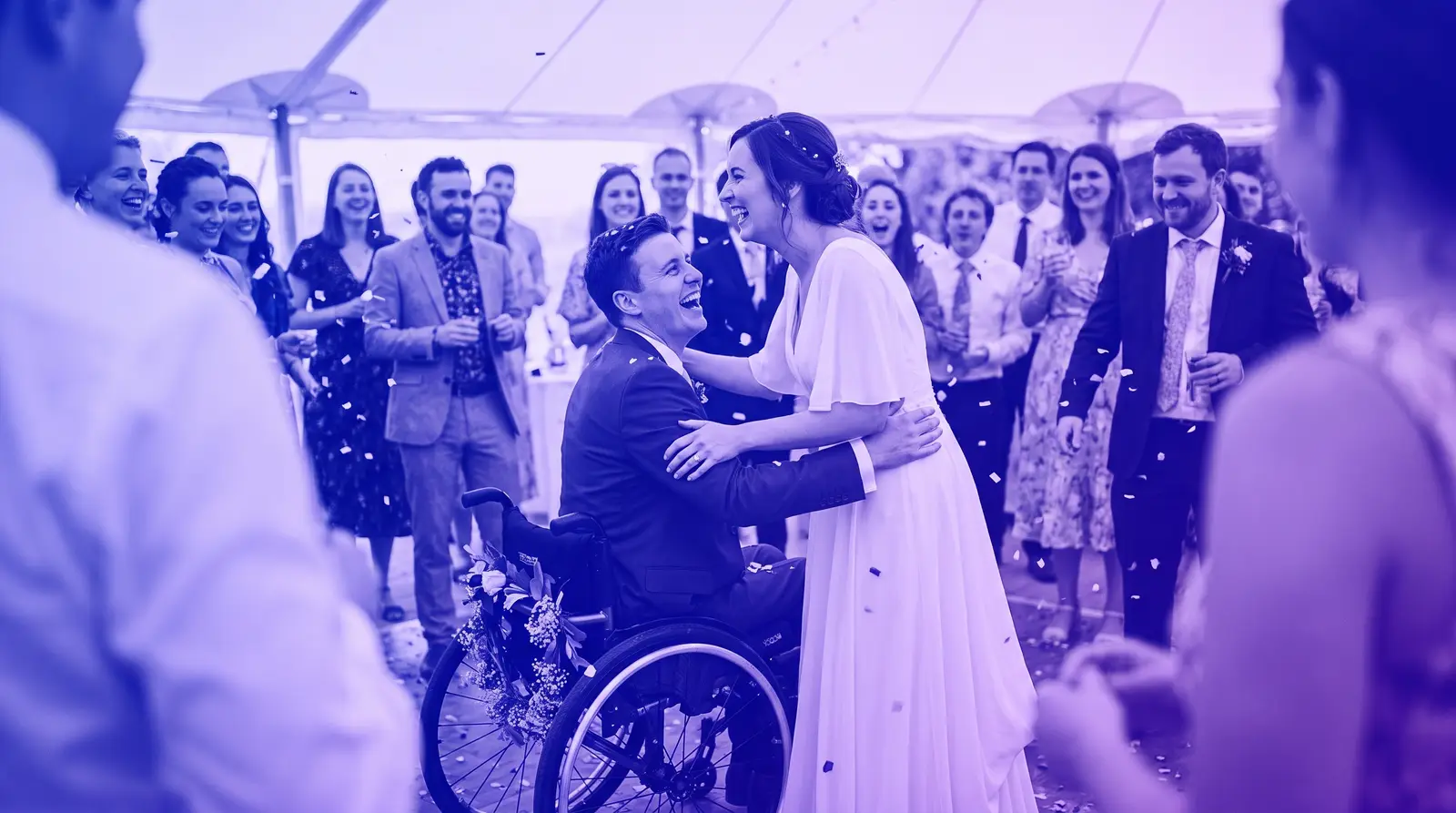
Accessibility touches every vendor, not just venues.
| Vendor category | Accessibility questions to ask |
|---|---|
| Wedding planner | Do you build accessibility checks into timelines, vendor communication, seating, transportation, and guest experience? |
| Venue | Are entrances, restrooms, ceremony spaces, reception areas, parking, getting-ready rooms, and rain plans accessible? |
| Photographer | Do you have experience posing disabled couples or wedding parties respectfully? Can you adapt portrait locations? |
| Videographer | Can you support captioning, audio clarity, and accessible delivery formats? |
| DJ/band | Can volume, lighting, and sensory intensity be adjusted? Can announcements be coordinated with captions or interpreters? |
| Caterer | Can you handle allergies, texture needs, dietary restrictions, and clear menu labeling? |
| Florist/decorator | Will decor block pathways, ramps, sightlines, or mobility routes? |
| Beauty team | Can services be done seated, in accessible rooms, with flexible timing and breaks? |
| Transportation | Are accessible shuttles, drop-off routes, and parking plans available? |
| Officiant | Can the ceremony include seated vows, interpreter placement, microphones, or alternate formats? |
| Stationery/website | Are invitations, wedding websites, schedules, and PDFs readable and accessible? |
How to find accessible wedding vendors near you
Search broadly first, then ask specific questions.
| Goal | Search query |
|---|---|
| General accessibility | accessible wedding vendors near me |
| Disability-owned vendors | disability-owned wedding vendors near me |
| Accessible venues | wheelchair accessible wedding venue [city] |
| Planning support | accessible wedding planner [city] |
| Deaf accessibility | wedding ASL interpreter [city], Deaf-friendly wedding vendors [city] |
| Sensory needs | sensory-friendly wedding venue [city] |
| Mobility access | step-free wedding venue [city] |
| Inclusive photography | disability-inclusive wedding photographer [city] |
| Certification | DOBE wedding vendor, disability-owned business wedding [city] |
Also check:
- Venue accessibility pages.
- Google reviews mentioning elevators, ramps, restrooms, parking, or staff support.
- Photos of entrances and ceremony/reception areas.
- Wedding blogs featuring disabled couples.
- Disability-owned business directories.
- Disability:IN supplier resources.
- Local disability organizations.
- Planner portfolios that discuss accessibility directly.
Accessibility questions for venues
The venue is usually the most important accessibility decision.
| Area | Questions to ask |
|---|---|
| Parking/drop-off | Is accessible parking close to the entrance? Is the drop-off route step-free? |
| Entrance | Is the main entrance accessible, or is access through a side/back entrance? |
| Ceremony space | Can wheelchair users sit with their group instead of in a separate area? |
| Reception space | Are aisles wide enough for mobility devices after tables, chairs, and decor are installed? |
| Restrooms | Are accessible restrooms on the same level as the event? Are they truly usable? |
| Getting-ready rooms | Are suites accessible for the couple and wedding party? |
| Elevators | Are they reliable, large enough, and available during the entire event? |
| Outdoor areas | Are paths stable, level, and usable in rain? |
| Lighting/sound | Can lighting effects, strobes, volume, and announcements be adjusted? |
| Service animals | Does staff understand service animal rules? |
| Emergency plans | How are disabled guests supported during an evacuation or severe weather? |
Do not accept “Yes, we’re ADA-compliant” as the only answer. Ask what that means in practice.
Accessibility questions for planners
A strong planner should be able to coordinate accessibility across vendors.
Ask:
- Do you include accessibility questions in your planning intake?
- Do you ask guests about access needs before finalizing layout?
- Can you coordinate interpreters, captions, mobility routes, seating, and quiet areas?
- Do you review floor plans for wheelchair access after decor is placed?
- Can you build breaks into the timeline?
- How do you communicate access information to guests before the wedding?
- Have you worked with disabled couples or disabled wedding party members before?
- How do you handle accessibility if the venue has limitations?
A planner who says “We’ll figure it out on the day” is not planning.
Digital accessibility matters too
Weddings now rely on websites, PDFs, online RSVPs, registry pages, maps, schedules, and email updates. If those are inaccessible, guests can miss critical information.
The W3C’s Web Content Accessibility Guidelines are organized around making web content perceivable, operable, understandable, and robust. For wedding purposes, that means practical things like readable contrast, keyboard-friendly forms, descriptive links, clear headings, alt text for important images, and PDFs that are not just unreadable image scans.
For wedding websites and invitations, consider:
| Item | Better practice |
|---|---|
| Wedding website | Clear headings, readable text, accessible RSVP form, keyboard navigation |
| PDFs | Avoid image-only PDFs; provide text versions |
| Maps | Include written directions, not only embedded maps |
| Schedule | Provide plain-text schedule with locations and access notes |
| Photos | Use alt text when images convey important information |
| Colors | Use strong contrast for text |
| Links | Use descriptive links like “View hotel accessibility details,” not “click here” |
| Captions | Caption important videos when possible |
How to talk about access needs without making guests feel singled out
A helpful RSVP question might be:
“We want everyone to be able to participate comfortably. Please share any access needs, dietary restrictions, seating needs, sensory considerations, or communication preferences you would like us to know.”
This works better than asking only, “Do you need wheelchair access?” Accessibility is broader than mobility.
How to verify disability ownership respectfully
Do not ask intrusive medical questions. Ownership verification should be about the business, not personal health details.
Try:
“We’re trying to support disability-owned businesses where possible. Is disability-owned or DOBE-certified an accurate way to describe your business?”
Or:
“For vendor credits, is there a preferred way you describe your business — disability-owned, accessibility-forward, inclusive, or another term?”
Respect privacy. Some business owners may identify publicly. Others may not. A directory should never pressure someone to disclose disability.
What an accessibility-forward review should include
A useful review might say:
“We worked with [Vendor Name] for our wedding in [City]. They helped us plan step-free routes, accessible seating, clear timelines, and a quieter space for guests who needed a break. They treated accessibility as part of good hospitality, not a burden.”
Include specifics:
- Venue layout
- Parking/drop-off
- Restroom access
- Communication support
- Sensory considerations
- Mobility routes
- Service animal support
- Staff attitude
- Whether access information was clear before the event
Mistakes to avoid
- Assuming “ADA-compliant” means easy, comfortable, or dignified access.
- Listing a vendor as disability-owned without confirmation.
- Treating accessibility as only wheelchair access.
- Forgetting Deaf, blind, neurodivergent, chronically ill, and sensory-sensitive guests.
- Placing wheelchair users in separate seating areas.
- Using decor that blocks ramps, aisles, elevators, or restroom paths.
- Making guests ask for basic access information privately.
- Publishing inaccessible wedding websites or PDFs.
- Treating service animals like pets.
- Waiting until the wedding day to solve access problems.
FAQ
What is the best way to find accessible wedding vendors near me?
Search by vendor type and access need: “accessible wedding planner near me,” “wheelchair accessible wedding venue [city],” “Deaf-friendly wedding photographer [city],” or “sensory-friendly wedding venue [city].” Then ask detailed questions about physical access, communication, sensory needs, and vendor experience.
Is disability-owned the same as accessible?
No. Disability-owned describes ownership. Accessible describes the service, space, communication, or digital experience. A business can be one, both, or neither.
What is DOBE certification?
DOBE stands for Disability-Owned Business Enterprise. Disability:IN describes DOBE certification as generally requiring a business to be at least 51% owned, operated, managed, and controlled by people with disabilities.
Should I ask vendors about accessibility before booking?
Yes. Accessibility should be part of the vendor selection process, not a last-minute add-on.
What should I ask an accessible wedding venue?
Ask about parking, entrances, restrooms, elevators, ceremony seating, reception layout, outdoor paths, service animals, quiet areas, lighting, sound, and emergency plans.
Suggested external sources
- The Knot Worldwide — 2026 Real Weddings Study: https://www.theknotww.com/press-releases/the-knot-worldwide-unveils-2026-real-weddings-study
- Disability:IN DOBE certification: https://disabilityin.org/learning-and-development/supplier-development
- ADA.gov Service Animals: https://www.ada.gov/resources/service-animals-2010-requirements/
- W3C WCAG 2.2: https://www.w3.org/TR/WCAG22/
- W3C WCAG overview: https://www.w3.org/WAI/standards-guidelines/wcag/
Bottom line
A wedding should not require guests or couples to fight for access.
Searching for accessible wedding vendors near me can help couples find planners, venues, photographers, DJs, caterers, beauty teams, transportation providers, and officiants who understand that accessibility is part of hospitality. Searching for disability-owned vendors can also help couples support disabled entrepreneurs directly.
The key is to be specific. Do not rely on vague claims. Ask what is actually accessible. Verify ownership respectfully. Put access details on the invitation or wedding website before guests have to ask. Credit vendors who do this well.
Keep reading
Disability-Owned Businesses
Disability-Owned and Accessibility-Forward Brands to Support in 2026
Disability-Owned Businesses
Disability-Owned and Accessible Salons Near Me: How to Find Beauty Businesses That Are Actually Usable in 2026
Disability-Owned Businesses
Disability-Owned Businesses in 2026: How to Find, Support, and Build More Accessible Local Economies
Own or know an inclusive business?
List it free so people can discover it year-round — with a source you control.
List your business