Trust & Verification
How to Find a Mechanic You Can Trust
Updated September 29, 2026Consumer Guide
On this page (13 sections)
- Start with the same things everyone should look for
- Then look for signs you'll be treated with respect
- A few things that would make us pause
- Ask for your old parts back
- How to handle upsells
- Get a second opinion on big repairs
- Dealer or independent shop?
- Paying, and what to do if something goes wrong
- Where to look
- A simple checklist
- FAQ
- Find auto services near you
- Sources
A good mechanic fixes what's actually wrong, explains it clearly, charges a fair price and treats you with respect. Here's how to find one.
Car repairs can be stressful. The bill is often unexpected, the car is how you get to work, and the person behind the counter usually knows more about it than you do.
That knowledge gap is where things can go wrong.
A trustworthy shop closes the gap. It explains, it puts things in writing and it treats every customer the same, whether you rebuild engines on weekends or just know the car makes a noise.
Look for skill and respect. You deserve both.
Start with the same things everyone should look for
Before anything else, make sure the shop is good at the job.
1. Their technicians are certified
The most widely recognized credential is from ASE, the National Institute for Automotive Service Excellence. It's a nonprofit the auto industry set up in 1972.
To be ASE certified, a technician has to pass a test and have hands-on work experience. Certifications cover specific areas, such as brakes or engine repair, and must be renewed every five years.
Some shops earn ASE's Blue Seal of Excellence recognition, which requires that at least 75% of their staff be ASE certified.
Good sign: Certificates are posted where you can see them, and the person at the counter can tell you who will work on your car.
2. They give you a written estimate
Before any work starts, you should get an estimate in writing that lists the problem, the parts and the labor.
Many states have rules about this. In California, shops must give you a written estimate before doing repairs. In Florida, if a repair will cost more than $150, the shop has to offer you a written estimate, and it needs your approval before going more than $10 or 10% over, whichever is greater.
Rules vary by state, so check yours with your state attorney general or consumer protection office.
3. They call before doing more
Say this out loud when you drop off the car: "Please call me before doing any work that isn't on the estimate."
A good shop does that anyway. It's worth saying.
4. They stand behind their work
There's no standard warranty on car repairs. Terms vary a lot from shop to shop.
Ask how long parts and labor are covered, whether there's a mileage limit and whether the warranty is honored at other locations if you're traveling. Get it on your invoice.
5. They know your kind of car
Some shops specialize in certain makes, in hybrids and electric vehicles, or in specific work like transmissions. Ask whether they see many cars like yours.
Then look for signs you'll be treated with respect
A shop doesn't need to advertise inclusion to practice it. But you should never feel talked down to.
They talk to you, not around you
Good staff speak directly to the person who brought the car in. They don't assume what you know based on your gender, your age or how you describe the problem. They don't redirect the conversation to whoever came with you.
They explain in plain language
You should leave understanding what's wrong, why it matters and what happens if you wait.
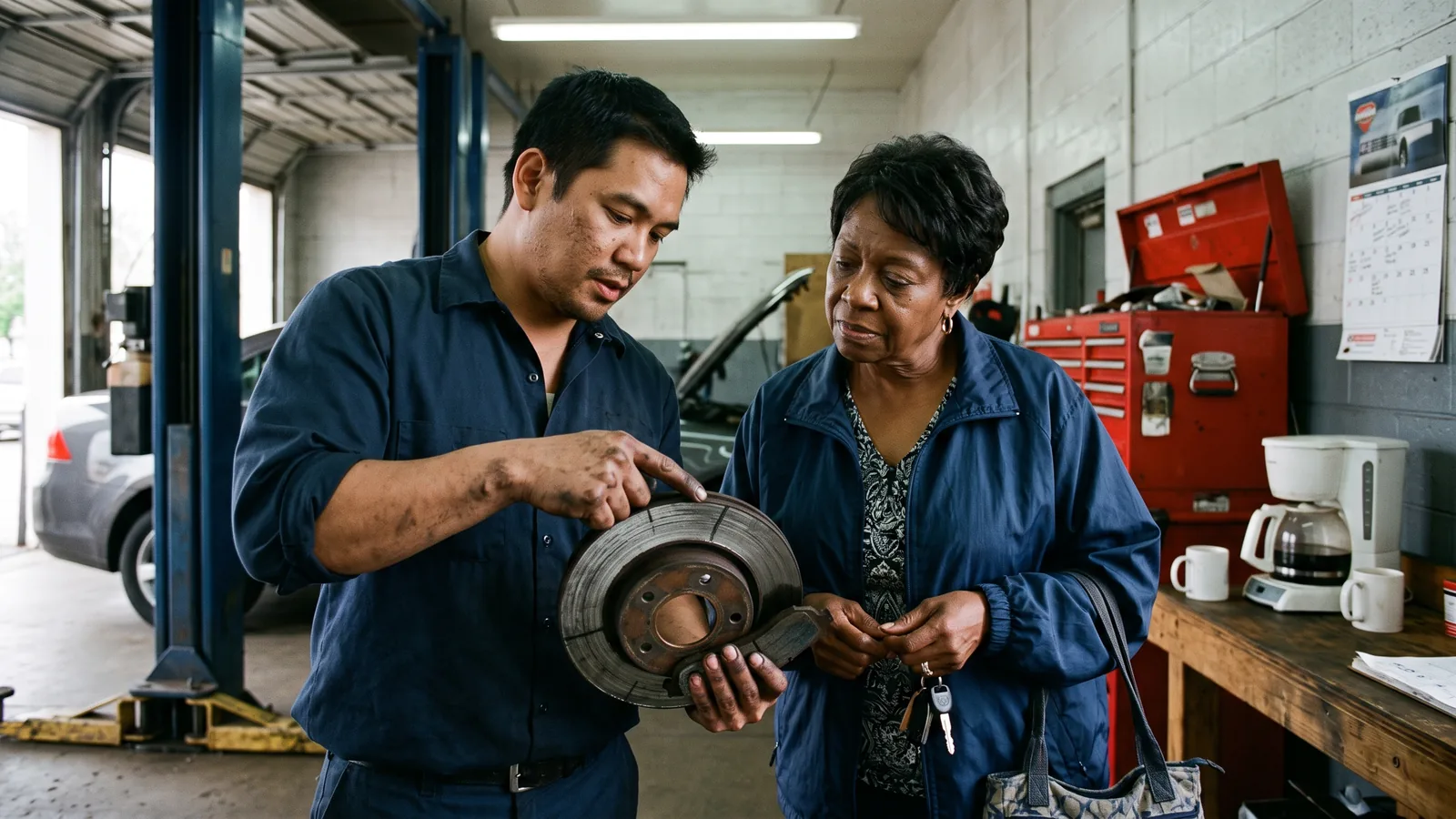
A good mechanic can show you the worn part, point to the leak or share a photo. If you ask a question, you get an answer, not a sigh.
They treat everyone the same on price
A fair shop quotes the same job the same way no matter who is asking. A written estimate, with parts and labor broken out, is your best protection. It also makes comparing shops easy.
They make communication work for you
If you're more comfortable in a language other than English, ask whether anyone at the shop speaks it. If not, ask whether they'll text or email the estimate so you can read it at your own pace or in a translation app.
If you're deaf or hard of hearing, or just prefer writing, ask whether they'll communicate by text.
Their space works for everyone
If you'll wait for your car, is the waiting area accessible? Is there seating that works for you, a restroom you can use and a step-free way in?
If they offer a shuttle or loaner, ask whether it can accommodate a wheelchair or a child's car seat, and how far it goes.
A few things that would make us pause
They won't put the estimate in writing. A verbal number is easy to change later.
Everything is urgent. Some repairs really can't wait. But if every item is a safety emergency and the price only holds if you decide right now, slow down.
They won't show you the problem. A confident mechanic is happy to point at the worn brake pad.
They explain things to someone else in the room. You brought the car in. The conversation is with you.
The bill doesn't match the estimate, and nobody called. That's exactly what the estimate is supposed to prevent.
Ask for your old parts back
Asking for the parts that were replaced is a simple way to confirm the work was done.
Ask when you approve the estimate, not after. In some states, including California and Florida, you have a right to get replaced parts back if you ask at the start. Some parts, like those returned to the supplier under warranty or exchanged for a core charge, may be kept, but the shop can usually let you see them.
How to handle upsells
Your owner's manual has a maintenance schedule from the manufacturer. That schedule, not a shop's generic chart, tells you when your car actually needs oil changes, fluid services and other maintenance.
When a shop recommends something, ask:
- Is this on my owner's manual schedule?
- Is it needed now, or can it wait until my next visit?
- What happens if I wait?
A good shop tells you honestly which items are urgent and which are "keep an eye on it."
Get a second opinion on big repairs
For expensive or complicated work, getting a second opinion is reasonable. You'll likely pay for the diagnosis, but that can be worth it on a big job.
Take the first written estimate with you so the second shop can compare.
A good mechanic won't be offended that you're checking. It happens all the time.
Dealer or independent shop?
Both can be excellent.
Dealers usually work on one brand every day and have that manufacturer's tools and training. Independent shops are often less expensive and may give you more direct contact with the person working on your car.
For warranty repairs that are free, the dealer is usually where you go. For routine maintenance, you have a choice. The Federal Trade Commission says it's illegal for a dealer to deny your warranty coverage just because you had routine maintenance or repairs done somewhere else.
Keep your receipts either way. They show the car was maintained on schedule.
Paying, and what to do if something goes wrong
Before you pay, compare the invoice to the estimate. Every part and labor charge should be listed. Ask about anything you don't understand.
Keep the estimate, invoice and any warranty terms together.
Paying by credit card can give you the right to dispute a charge in some situations. The FTC explains the conditions.
If there's a problem, start with the shop. Explain calmly what went wrong and what you'd like them to do. Many problems get fixed right there.
If that doesn't work, you can file a complaint with your state attorney general or consumer protection office. Some states also have an agency that registers repair shops and takes complaints.
This is general information, not legal advice.
Where to look
Combine a trusted source with a personal referral. One tells you about standards. The other tells you how the shop treats real people.
| Source | What it gives you |
|---|---|
| AAA Approved Auto Repair locator | Shops that meet AAA standards and inspections, with a 24-month or 24,000-mile repair warranty for AAA members |
| ASE certification and Blue Seal recognition | Evidence that technicians have passed tests and have work experience |
| Your state's repair shop registration, where one exists | Whether a shop is registered with the state |
| Friends, neighbors and coworkers | Names vouched for by people who've paid the bill |
| Inclusive business directories | Auto services listed with a source you can check |
A listing anywhere is a lead to investigate, not a final answer.
A simple checklist
Before you leave your car, ask yourself:
- Are the technicians ASE certified or similarly trained?
- Do I have a written estimate with parts and labor listed?
- Did I ask them to call before doing extra work?
- Did I ask for my old parts back?
- Do I know the warranty on parts and labor?
- Did they explain the problem clearly and speak directly to me?
- Do recommended services match my owner's manual schedule?
If the answers are yes, you may have found a mechanic worth keeping.
FAQ
What does ASE certified mean?
It means a technician passed a test from the National Institute for Automotive Service Excellence and has hands-on work experience. Certifications are by specialty, such as brakes or engine repair, and must be renewed every five years, so ask which areas a technician is certified in.
Does a shop have to give me a written estimate?
It depends on your state. California requires a written estimate before repairs, and Florida requires shops to offer one when a repair will cost more than $150, but rules vary. Check with your state attorney general or consumer protection office, and ask for one in writing either way.
Will using an independent shop void my car's warranty?
According to the Federal Trade Commission, it's illegal for a dealer to deny warranty coverage just because routine maintenance or repairs were done somewhere else. Free warranty repairs may still need to go through the dealer. Keep receipts for all maintenance.
Should I ask for my old parts back?
Yes, and ask when you approve the estimate. It's a simple way to confirm the work was done, and some states give you the right to get replaced parts back if you request them at the start.
How do I know if a recommended service is really needed?
Check the maintenance schedule in your owner's manual and ask the shop whether the item is needed now or can wait. A good mechanic will show you the problem and tell you honestly what's urgent.
What if I don't know much about cars?
You don't need to. A good shop explains the problem in plain language, shows you what's wrong and gives you the price in writing. If you ever feel talked down to, that's a reason to try another shop.
What should I do if I'm unhappy with a repair?
Start by talking to the shop and explaining what you'd like them to do. If that doesn't resolve it, keep your estimate and invoice and file a complaint with your state attorney general or consumer protection office.
Find auto services near you
And if you know a great one we should add:
Sources
- ASE, About ASE: https://www.ase.com/about-ase
- ASE, Work Experience Requirements: https://www.ase.com/work-experience
- AAA, Approved Auto Repair: https://www.aaa.com/autorepair/
- Federal Trade Commission, Auto Repair Basics: https://consumer.ftc.gov/articles/auto-repair-basics
- Federal Trade Commission, Auto Warranties and Auto Service Contracts: https://consumer.ftc.gov/articles/auto-warranties-and-auto-service-contracts
- Federal Trade Commission, Nixing the Fix: Warranties, Mag-Moss, and Restrictions on Repairs: https://www.ftc.gov/business-guidance/blog/2019/03/nixing-fix-warranties-mag-moss-restrictions-repairs
- Federal Trade Commission, Using Credit Cards and Disputing Charges: https://consumer.ftc.gov/articles/using-credit-cards-and-disputing-charges
- California Bureau of Automotive Repair, Write It Right: https://www.bar.ca.gov/wir
- Florida Department of Agriculture and Consumer Services, Motor Vehicle Repair: https://www.fdacs.gov/Consumer-Resources/Consumer-Rights-and-Responsibilities/Motor-Vehicle-Repair
Keep reading


Own or know an inclusive business?
List it free so people can discover it year-round — with a source you control.
List your business