Trust & Verification
How to Find a Welcoming, Accessible Place to Stay
Updated September 29, 2026Consumer Guide
On this page (16 sections)
- Start with the same things everyone should look for
- Then look for signs you'll be welcome
- A few things that would make us pause
- Booking an accessible room
- Same-sex couples and one-bed bookings
- Trans travelers and ID at check-in
- Traveling with a service animal
- Families with kids
- Language access
- Reading reviews between the lines
- If something goes wrong when you arrive
- Where to look
- A simple checklist
- FAQ
- Find a place to stay near you
- Sources
A good place to stay should be comfortable, honest about what it offers and glad to have you. Here's how to find one before you book.
A trip can go wrong in small ways. The accessible room has a tub instead of a roll-in shower. A clerk questions your one-bed booking. A fee appears at checkout.
Most of that can be caught before you arrive.
You shouldn't have to choose between a well-run place and one where you feel welcome. Look for both.
Start with the same things everyone should look for
First, make sure the place itself is a good bet.
1. The location actually works for you
Look at the map, not just the neighborhood name.
How far is it from where you need to be? Is there accessible transit nearby? What does parking cost? Is the walk back at night one you'd be comfortable making?
2. You understand the cancellation terms
Read them before you pay.
Some rates are nonrefundable. Some let you cancel free until a certain date or time. Third-party booking sites can have different rules than booking directly.
Good sign: The terms are easy to find and written in plain language.
3. You know the real price
Under a Federal Trade Commission rule that took effect in May 2025, hotels and short-term rentals that show a price must show the total, including mandatory fees like resort fees and cleaning fees. Taxes can still be added separately.
Optional extras like parking or early check-in can still cost more. Ask what you'll pay for the things you'll use.
Then look for signs you'll be welcome
A place doesn't need a rainbow flag or a special program to treat every guest well. But you shouldn't have to wonder whether you will be.
Look at how they present themselves
Check the website and listing. Is accessibility information detailed, or a single line? Do they mention welcoming LGBTQ+ travelers, families of every shape or guests who speak other languages?
Welcoming language alone doesn't prove anything. It's one useful signal.
Pay attention to whether they ask or assume
Good staff don't guess who you are traveling with, what your relationship is, which name you use or what help you need. They ask, and then they listen.
A few things that would make us pause
Accessibility information is missing or vague. "Accessible room available" doesn't tell you whether it has a roll-in shower or a tub with a grab bar.
They can't tell you the total price. If a direct question about fees gets a runaround, expect surprises at checkout.
Staff seem uncomfortable with a simple request. One bed for two people, a name different from the one on your card, a service dog. None of this should be a big deal.
Something feels off in the first conversation. It's okay to pick somewhere else.
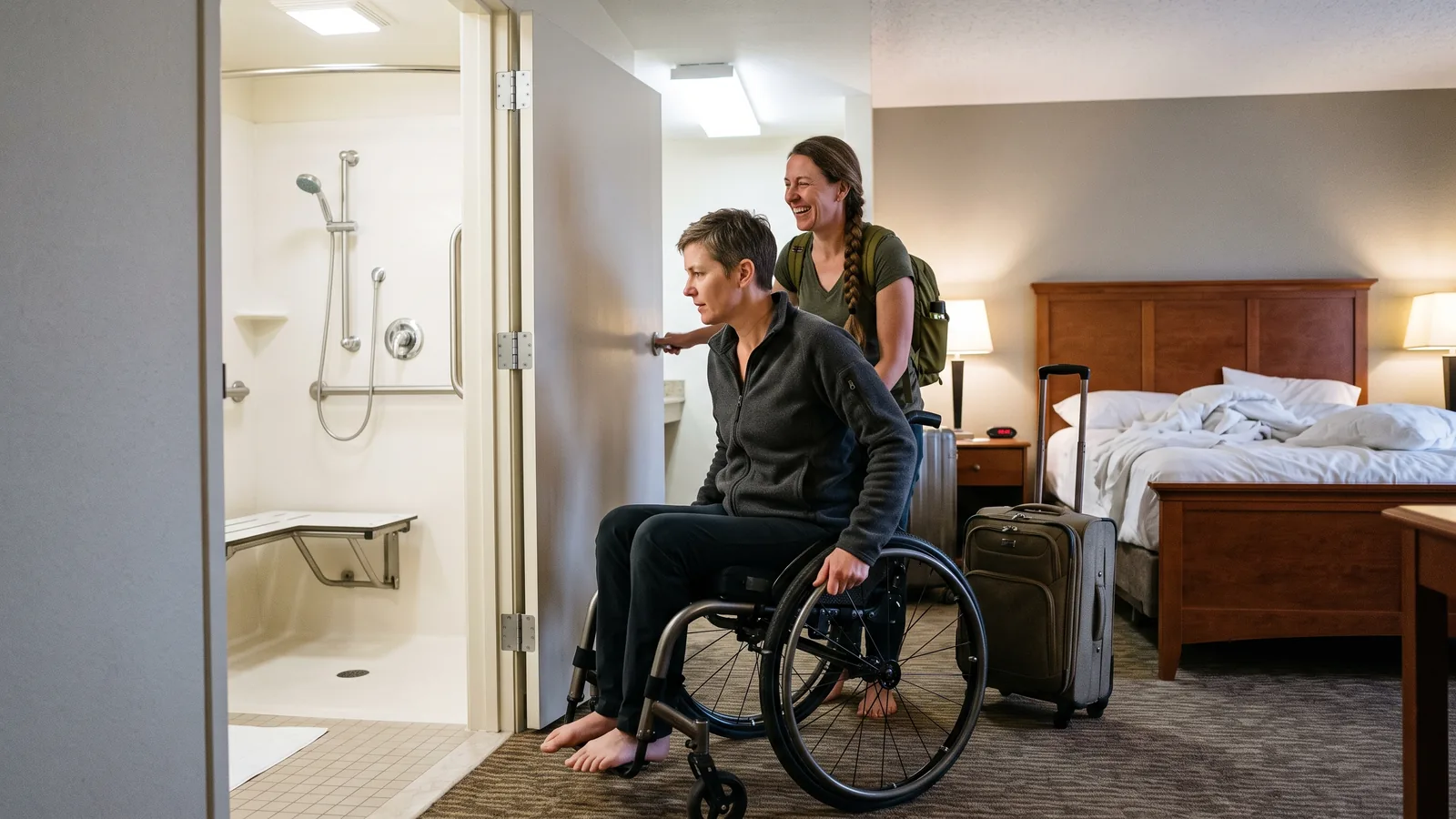
Booking an accessible room
Under the Americans with Disabilities Act rules that apply to hotels, you should be able to reserve an accessible room during the same hours and in the same way as any other room. That means if others can book online, you should be able to book an accessible room online too.
Hotels also have to describe the accessible features of the hotel and its rooms in enough detail for you to judge for yourself whether a room meets your needs.
Once you reserve a specific accessible room, the hotel is supposed to hold that room for you and block it from being booked by anyone else.
In practice, descriptions can still be thin. So ask specific questions, and get the answers in writing:
- Is the shower a roll-in shower, a transfer shower or a tub with grab bars?
- How high is the bed, and is there clear space under it for a lift?
- How wide are the doorways, and is there clear floor space beside the bed?
- Does the room have visual alarms and a visual door knock or phone indicator?
- Is the route from parking or the entrance to the room step-free?
- Are the pool, fitness room, breakfast area and other shared spaces accessible?
Call the property itself, not only a central reservations line. Then confirm by email a few days before you arrive.
This is general information, not legal advice.
Same-sex couples and one-bed bookings
If you book one bed, you should get one bed.
If a clerk "helpfully" switches you to two beds or asks whether you're sure, a calm "One bed is right, thank you" is enough. A note on your reservation, or booking directly with the property, can prevent the mix-up.
Federal law bars hotels from discriminating based on race, color, religion or national origin. Protections for sexual orientation and gender identity in hotels and other public places depend on state and local law. Many states and cities have them, but not all. The Movement Advancement Project keeps a state-by-state map.
Trans travelers and ID at check-in
Many hotels ask to see a government-issued photo ID and the card you're paying with when you check in.
If the name on your ID doesn't match the name you use, it can help to book under the name on your ID and add a note with the name you'd like staff to use. Having the reservation, ID and payment card all match makes check-in faster.
A good front desk handles this quietly. They use the name you ask them to use, and they don't read your legal name out loud.
Call ahead and ask how they handle a guest whose ID shows a different name. The tone of the answer tells you a lot.
Traveling with a service animal
Under the ADA, a service animal is a dog that is individually trained to do work or perform tasks for a person with a disability. There is a separate provision for trained miniature horses.
Dogs whose only role is comfort or emotional support are not service animals under the ADA.
Staff may ask only two questions: whether the dog is required because of a disability, and what work or task it has been trained to do. They can't charge a pet fee or deposit for a service animal. They can charge for damage the animal causes, the same as for any guest.
A hotel can ask you to remove a service animal only if it is out of control and you don't take effective action, or if it isn't housebroken.
Families with kids
Before you book, ask how many people are allowed in the room and whether extra guests cost more. Ask whether cribs or rollaway beds are available, whether connecting rooms can be guaranteed and whether there's a refrigerator.
A place that answers kindly, whatever your family looks like, is likely a good fit.
Language access
If you or someone you're traveling with is more comfortable in a language other than English, ask whether anyone on staff speaks it.
If not, ask them to put important details in writing by email or text, so you can read them in a translation app at your own pace.
Reading reviews between the lines
Reviews can tell you what a property's own website won't.
Search reviews for words that matter to you: "wheelchair," "roll-in," "service dog," "kids," "couple" or the language you speak.
Watch for patterns. One bad review is noise. Five describing the same rude front desk is a pattern.
Notice how management responds, too. A thoughtful reply that fixes a problem is a good sign. A defensive one is not.
If something goes wrong when you arrive
Be specific. "My confirmation says roll-in shower, and this room has a tub" gets further than "This isn't what I booked."
Show your confirmation. Ask for a manager if needed, and ask what they will do now: move you, find you a comparable room nearby or refund you. Write down names, times and what was said.
If the issue is disability access, you can file a complaint with the U.S. Department of Justice through its Civil Rights Division. For hidden fees or billing problems, you can report to the Federal Trade Commission or your state attorney general. For other discrimination, check your state or city civil rights agency.
This is general information, not legal advice.
Where to look
Combine a specialized source with a personal referral.
| Source | What it gives you |
|---|---|
| IGLTA (International LGBTQ+ Travel Association) | Member accommodations and travel businesses that have joined an LGBTQ+ welcoming travel network |
| The property's own accessibility page | The features the hotel says each room has, to confirm by phone |
| HRC Corporate Equality Index | Workplace policy scores for many large U.S. companies, useful when comparing big chains |
| Friends and family who have stayed there | Honest answers from someone who has been through the door |
| Inclusive business directories | Places to stay listed with a source you can check |
A listing anywhere is a lead to investigate, not a final answer.
A simple checklist
Before you book, ask yourself:
- Do I understand the cancellation terms?
- Do I know the total price, including fees for things I'll use?
- If I need an accessible room, do I have the specific features confirmed in writing?
- Did they answer my questions clearly and kindly?
- Do recent reviews give me confidence?
If the answers are yes, you've likely found a good place to stay.
FAQ
Can a hotel make me call to book an accessible room?
Under ADA rules, hotels are required to let guests reserve accessible rooms during the same hours and in the same way as other rooms, so if others can book online, you should be able to as well. It's still smart to call the property after booking to confirm the specific features you need.
What if the accessible room I booked isn't available when I arrive?
Hotels are supposed to hold the specific accessible room you reserved. Show your confirmation, ask for a manager and ask how they will fix it. Write down names and times; you can file a complaint with the U.S. Department of Justice if needed.
Can a hotel charge a pet fee for my service dog?
No. Under the ADA, a hotel can't charge a pet fee or deposit for a service animal, though it can charge for damage the animal causes, as it would for any guest. Emotional support animals are not service animals under the ADA, so hotel pet policies may apply to them.
I'm trans and my ID shows a different name. How should I book?
Many travelers book under the name on their ID so the reservation, ID and payment card match, then add a note with the name they'd like staff to use. Calling ahead to ask how the hotel handles it can also tell you a lot.
Are resort fees included in the price I see?
Under a Federal Trade Commission rule in effect since May 2025, hotels and short-term rentals that show a price must include mandatory fees like resort and cleaning fees in the total, while taxes can be shown separately. Optional extras, like parking, may still cost more.
How do I find LGBTQ+ welcoming places to stay?
IGLTA, the International LGBTQ+ Travel Association, has member accommodations and travel businesses you can browse. Pair that with recent reviews and a quick call to the property.
Find a place to stay near you
Browse places to stay and travel services near you
And if you know a great one we should add:
Sources
- Legal Information Institute, 28 CFR 36.302, Modifications in policies, practices, or procedures: https://www.law.cornell.edu/cfr/text/28/36.302
- ADA.gov, ADA Requirements: Service Animals: https://www.ada.gov/resources/service-animals-2010-requirements/
- ADA.gov, File a Complaint: https://www.ada.gov/file-a-complaint/
- U.S. Department of Justice, Civil Rights Division, Report a Civil Rights Violation: https://civilrights.justice.gov/report
- U.S. Department of Justice, Title II of the Civil Rights Act (Public Accommodations): https://www.justice.gov/crt/title-ii-civil-rights-act-public-accommodations
- Movement Advancement Project, Nondiscrimination Laws: https://www.mapresearch.org/equality-maps/non_discrimination_laws
- Federal Trade Commission, The Rule on Unfair or Deceptive Fees: Frequently Asked Questions: https://www.ftc.gov/business-guidance/resources/rule-unfair-or-deceptive-fees-frequently-asked-questions
- Federal Trade Commission, FTC Rule on Unfair or Deceptive Fees to Take Effect on May 12, 2025: https://www.ftc.gov/news-events/news/press-releases/2025/05/ftc-rule-unfair-or-deceptive-fees-take-effect-may-12-2025
- IGLTA, International LGBTQ+ Travel Association: https://www.iglta.org/
- IGLTA, Accommodations: https://www.iglta.org/plan-your-trip/accommodations/
- Human Rights Campaign, Corporate Equality Index: https://www.hrc.org/resources/corporate-equality-index
- Human Rights Campaign, Travel and Passport Rights for Transgender People: https://www.hrc.org/resources/travel-passport-rights-for-transgender-people
Keep reading


Own or know an inclusive business?
List it free so people can discover it year-round — with a source you control.
List your business