Local City Guides
Asian-Owned Businesses in Phoenix to Support in 2026
Updated August 15, 2026Local Guide
On this page (9 sections)
The Asian-owned businesses in this guide span Thai, Vietnamese, Korean, Japanese, Indian and Pakistani, and Middle Eastern kitchens, along with the markets that sell the ingredients and a henna studio.
Phoenix does not have a single Asian commercial district the way some cities do, which means these are scattered rather than walkable. That makes a list more useful here than it would be somewhere with one street to point at.
Quick answer
- For Thai, Sala Thai Restaurant, Chanpen Thai Cuisine, and Yupha's Thai Kitchen.
- For Vietnamese, Banh Mi Bistro Vietnamese Eatery.
- For Korean, Bop and Roll, plus Busan Mart for groceries.
- For Japanese and sushi, Sake Haus.
- For Indian and Pakistani, Curry Corner.
- For Middle Eastern, Haji-Baba, which is a market and a restaurant in one.
- For dessert and boba, Mango Rabbit and Tea Snow.
- For gifts and books, Kinkan Gifts and Wijaya House.
- For henna and mehndi, Henna Shoppe.
- Our Phoenix hub lists these alongside every other category in the Valley.
Where should I eat?
Thai is the deepest bench. Sala Thai Restaurant serves made-to-order Thai street food in a casual room and is the one Enhanced listing among the restaurants here. Chanpen Thai Cuisine and Yupha's Thai Kitchen are both Asian-owned and women-owned.
Beyond Thai, the list spreads out by cuisine rather than doubling up:
| Cuisine | Where to go |
|---|---|
| Thai | Sala Thai Restaurant, Chanpen Thai Cuisine, Yupha's Thai Kitchen |
| Vietnamese | Banh Mi Bistro Vietnamese Eatery |
| Korean | Bop and Roll |
| Japanese and sushi | Sake Haus |
| Indian and Pakistani | Curry Corner |
| Middle Eastern | Haji-Baba |
| Pan-Asian | Ricemill |
| Dessert, boba, and tea | Mango Rabbit, Tea Snow |
Worth noting what that table is not: a map of Phoenix proper. Most of these sit in Tempe and Mesa rather than the city itself, which is why this guide is framed around the metro.
Which markets are worth the trip?
Three, and they each do a different job. Busan Mart is a Korean market, and is women-owned as well as Asian-owned. Haji-Baba is a Middle Eastern market with a restaurant attached, which makes it the efficient stop: eat, then shop for what you just ate.
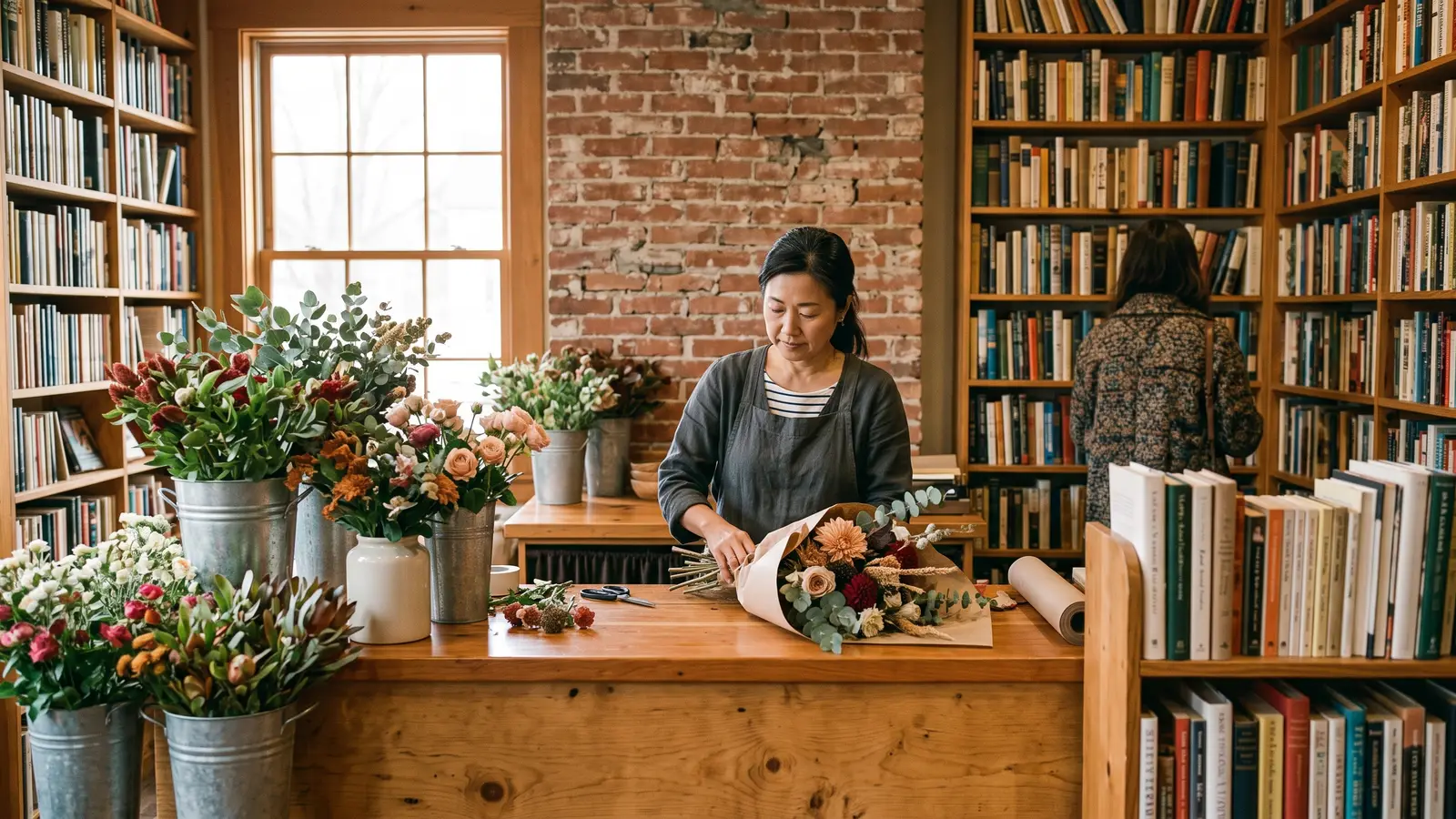
Wijaya House is the outlier and the most charming entry on this page, selling books and flowers together. It is Asian-owned and women-owned.
Where do I shop for gifts?
Kinkan Gifts is the dedicated gift shop, Asian-owned and women-owned. For something you cannot buy off a shelf, Henna Shoppe does henna and mehndi artistry alongside a handmade lifestyle boutique, and is the only Asian-owned business listed in the metro outside food and retail.
How much of this list is women-owned too?
A striking share. Nine of the fifteen Asian-owned businesses in our Phoenix metro directory also carry the women-owned tag: Sala Thai Restaurant, Chanpen Thai Cuisine, Yupha’s Thai Kitchen, Curry Corner, Mango Rabbit, Busan Mart, Kinkan Gifts, Wijaya House, and Henna Shoppe.
If you are shopping specifically to support women-owned businesses, that overlap is worth knowing, and it works in both directions on the site: a listing appears under every tag it carries.
Who should be on this page next?
We add to this page as businesses get listed, and the categories we are most actively looking to add in the Valley are attorneys, accountants, physicians, contractors, agents and technology firms.
Restaurant and market listings come first everywhere because those sources are public and quick to verify. Professional practices generally arrive when their owners add them.
If that is you, you would be the first one listed in your category, on a page that already gets search traffic. Listings are free to add.
How is ownership sourced?
Every listing carries a verification status. Publicly listed means ownership came from a public source. Self identified means the owner confirmed it directly. Certified means a third party verified it.
Ownership is never inferred from a business name, a cuisine, or an owner's surname. This category is the one where that rule does the most work, because the temptation to read ownership off a menu is strongest here and it is wrong often enough to matter. "Asian-owned" also covers a very large set of distinct communities, and the tag says nothing about which one; where we know the cuisine or the country, the listing says so.
Phoenix also has guides to its LGBTQ-owned, Black-owned, and Latino-owned businesses, and several listings appear on more than one of them.
Common mistakes
Reading ownership off the menu. A Thai restaurant is not evidence of a Thai owner, and an Asian-owned business is not necessarily an Asian restaurant. Cuisine and ownership are recorded separately here for exactly that reason.
Treating "Asian-owned" as one community. It spans dozens. The tag is a filter, not a description of a single group, and the specific cuisine or country appears on the individual listing where it is known.
Expecting a district. Phoenix does not have one concentrated Asian commercial neighborhood, so plan around the individual addresses rather than a walkable strip.
Assuming a tag is a certification. It is a sourced claim with a status attached. Formal certification is separate and displayed separately.
FAQ
How many Asian-owned businesses are listed in Phoenix?
Fifteen across the Phoenix metro as of August 2026: ten restaurants, four markets or shops, and one henna studio. That is what is recorded with a source attached, not a count of the city.
Is there an Asian district in Phoenix?
Not a single concentrated one comparable to the Chinatowns or Koreatowns of older or larger cities. The Asian-owned businesses in our directory are spread across the metro rather than clustered on one street, so a list is more practical than a neighborhood.
Where can I buy Korean groceries in Phoenix?
Busan Mart, in Tempe, is the Korean market listed in our Phoenix metro directory. It is Asian-owned and women-owned.
What Asian cuisines are represented?
Thai, Vietnamese, Korean, Japanese, Indian and Pakistani, and Middle Eastern, plus two pan-Asian kitchens and a dessert and boba pair. Thai has the most entries with three.
Are any of these businesses women-owned as well?
Nine of the fifteen carry both tags, including four restaurants, a Korean market, a gift shop, a bookstore and florist, a boba shop, and the henna studio.
Are there Asian-owned professional services in Phoenix?
Professional services are the categories we are most actively adding in the Valley: attorneys, accountants, physicians, contractors, agents and technology firms. If you run one, you would be the first listed in your category. Listings are free to add.
How do I add my business to the list?
Submit it for free. Basic listings cost nothing, and paid tiers add photos, your own description, and top-of-category placement.
Keep reading



Own or know an inclusive business?
List it free so people can discover it year-round — with a source you control.
List your business