Local City Guides
Latino-Owned Businesses in Atlanta to Support in 2026
Updated August 15, 2026Local Guide
On this page (9 sections)
Atlanta's Latino-owned listings are unusually South American. Three separate kitchens serve Venezuelan arepas, an Argentine bakery holds the only Featured listing in the category, and one restaurant works in Peruvian and Japanese at once. Mexican cooking is here too, but it does not dominate the way it does in most American city guides.
Twenty-seven listings across metro Atlanta carry the Latino-owned tag: sixteen restaurants, six shops, two bars, two nonprofits, and a co-working space.
Quick answer
- For Argentine empanadas and pastries, Belén de la Cruz Empanadas and Pastries.
- For arepas, Arepa Mia in Avondale Estates, Arepa Grill, and Don Arepacho.
- For Peruvian crossed with Japanese, Madre Selva.
- For Oaxacan food, Oaxaca. For central Mexican, El Valle.
- For Puerto Rican sandwiches and Spanish tapas, El Super Pan & La Metro.
- For plant-based, La Semilla and LaRayia's Bodega.
- For mezcal, Pata Negra Mezcaleria. For cocktails, El Malo.
- For crafts, art, and gifts, La Tiendita de Frida, No Mas! Hacienda, and El Mundo del Regalo.
- To support the civic side, Ser Familia and Living Walls, The City Speaks.
- Our Atlanta hub carries the full list.
Why are there three arepa places?
Because Atlanta has a substantial Venezuelan community, and this is one of the few American cities where that shows up in a directory this size.
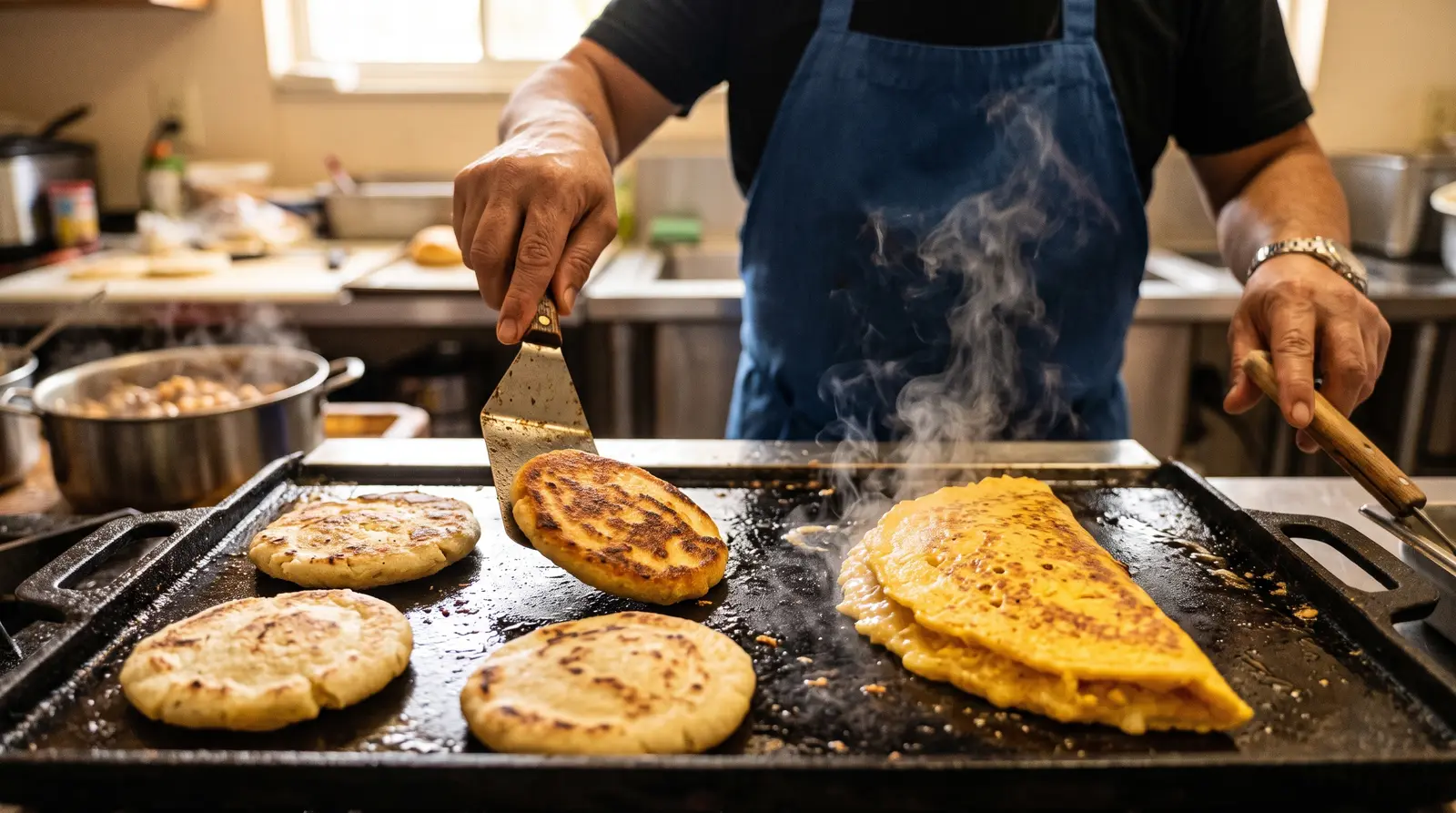
Arepa Mia is the one to start with: a chef-driven, entirely gluten-free Venezuelan kitchen serving arepas, cachapas, and empanadas. It is in Avondale Estates rather than Atlanta proper and carries a paid tier. Arepa Grill and Don Arepacho are the other two Venezuelan listings.
If you have never eaten a cachapa, that is the order to place. It is a sweet corn pancake folded around cheese and it does not resemble anything else on this list.
Where should I eat beyond that?
Belén de la Cruz Empanadas and Pastries is the highest-tier listing in the category: a family-owned Argentine bakery making empanadas, pastries, and cakes. Argentine baking is its own tradition, closer to Italian and Spanish pastry than to anything Mexican, and it is worth a trip on those terms.
Madre Selva works in Peruvian and Japanese, which sounds like fusion for its own sake and is in fact one of the oldest genuine culinary crossovers there is, with roots in Peru's Japanese community.
For Mexican, Oaxaca covers Oaxacan cooking, El Valle does central Mexican, CT Reforma and El Ponce are the neighborhood rooms, and El Santo Gallo works the street food end.
El Super Pan & La Metro pairs Puerto Rican sandwiches with Spanish tapas. Delicias de la Abuela is Latin home cooking, and Aroma Desserts and Bolivar Coffee cover dessert and coffee.
For plant-based, La Semilla is a Latin vegan eatery and LaRayia's Bodega is an Afro-Latina vegan bodega, which is also Black-owned.
Where should I shop?
Six retail listings, and they are more interesting than a restaurant list would suggest.
La Tiendita de Frida carries Mexican crafts and art. No Mas! Hacienda combines Latin home decor and art with a restaurant, so it works as both a meal and a shopping trip. El Mundo del Regalo does gifts and home decor.
El Rosario sells religious and cultural goods, which is the kind of shop that serves a community rather than a market. La Tiendita at El Ponce is a Latin American market, and Sandlux Apparel makes Latin-inspired fashion and is women-owned.
What is here beyond shopping and eating?
Three listings, and they are the ones that change something.
Ser Familia is a Georgia nonprofit strengthening Latino families through mental health services, education, and domestic violence support. It is based in Kennesaw, northwest of the city, and it is the only Latino-owned organization in our metro Atlanta records offering clinical services of any kind.
Living Walls, The City Speaks is a public art nonprofit and is women-owned as well. If you have looked at a mural in Atlanta, there is a reasonable chance this organization is why it is there.
Create Dunwoody is a co-working and entrepreneur space, which makes it the listing on this page most useful to someone starting a business rather than patronizing one.
Who should be on this page next?
We add to this page as businesses get listed, and the categories we are most actively looking to add in metro Atlanta are attorneys, accountants, physicians, dentists, contractors, roofers, landscapers and insurance agents.
Geography matters as much as category here. Much of the metro's Latino business activity sits along the Buford Highway corridor and in Chamblee, Doraville, Norcross and Gwinnett County, and those are the places we want next.
If that is you, you would be the first one listed in your category. Listings are free to add.
How is ownership determined?
Each listing shows a verification status. Publicly listed means ownership was recorded from a public source such as a chamber directory or the business's own description. Self identified means the owner told us directly. Certified means a third party verified it.
We never infer ownership from a surname, a photo, or the food a restaurant serves. A taqueria is not evidence of a Latino owner, and the reverse trap matters here too: three of the businesses on this page are Venezuelan and one is Argentine, and treating "Latino-owned" as a synonym for "Mexican" would misdescribe most of this list.
Atlanta also has guides to its Black-owned, women-owned, Asian-owned, and LGBTQ-owned businesses.
Common mistakes
Assuming Mexican. Venezuelan, Argentine, Peruvian, Puerto Rican, and Spanish cooking are all on this page, and the single highest-tier listing is an Argentine bakery.
Searching only inside the perimeter. The metro's densest Latino business corridors are along Buford Highway and out into Gwinnett, and none of them are in our records yet.
Missing the nonprofits. Ser Familia provides mental health and domestic violence support. That is a different kind of listing from a restaurant and it takes volunteers as readily as donations.
Treating a tag as a certification. Ownership tags are sourced claims with a status attached. Formal minority-business certification is separate and shown separately.
FAQ
How many Latino-owned businesses are listed in Atlanta?
Twenty-seven across metro Atlanta as of August 2026: sixteen restaurants and cafes, six retail shops, two bars, two nonprofits, and one co-working space. That is what is recorded with a source, not a count of the metro.
Where can I get arepas in Atlanta?
Three listings serve them: Arepa Mia in Avondale Estates, which is chef-driven and entirely gluten-free, plus Arepa Grill and Don Arepacho.
What is the best-known Latino-owned business in Atlanta?
Belén de la Cruz Empanadas and Pastries, a family-owned Argentine bakery, is the only Featured listing in this category. Arepa Mia is the other paid-tier entry.
Is there Peruvian food in Atlanta?
Madre Selva is listed as Peruvian and Japanese, a crossover with genuine roots in Peru's Japanese community.
Are there Latino-owned vegan restaurants in Atlanta?
Two: La Semilla, a plant-based Latin eatery, and LaRayia's Bodega, an Afro-Latina vegan bodega that is also Black-owned.
Why are there no listings on Buford Highway?
Because nothing has been published there yet. The Buford Highway corridor, Chamblee, Doraville, Norcross, and Gwinnett County hold much of the metro's Latino business community, and their absence here is a gap in our records rather than a fact about the area.
How do I add my business?
Submit it for free. A basic listing costs nothing; paid tiers add photos, your own description, and placement at the top of your category.
Keep reading
Own or know an inclusive business?
List it free so people can discover it year-round — with a source you control.
List your business